AI-Powered Route Optimization for Freight: Cutting Costs and Transit Times in 2026
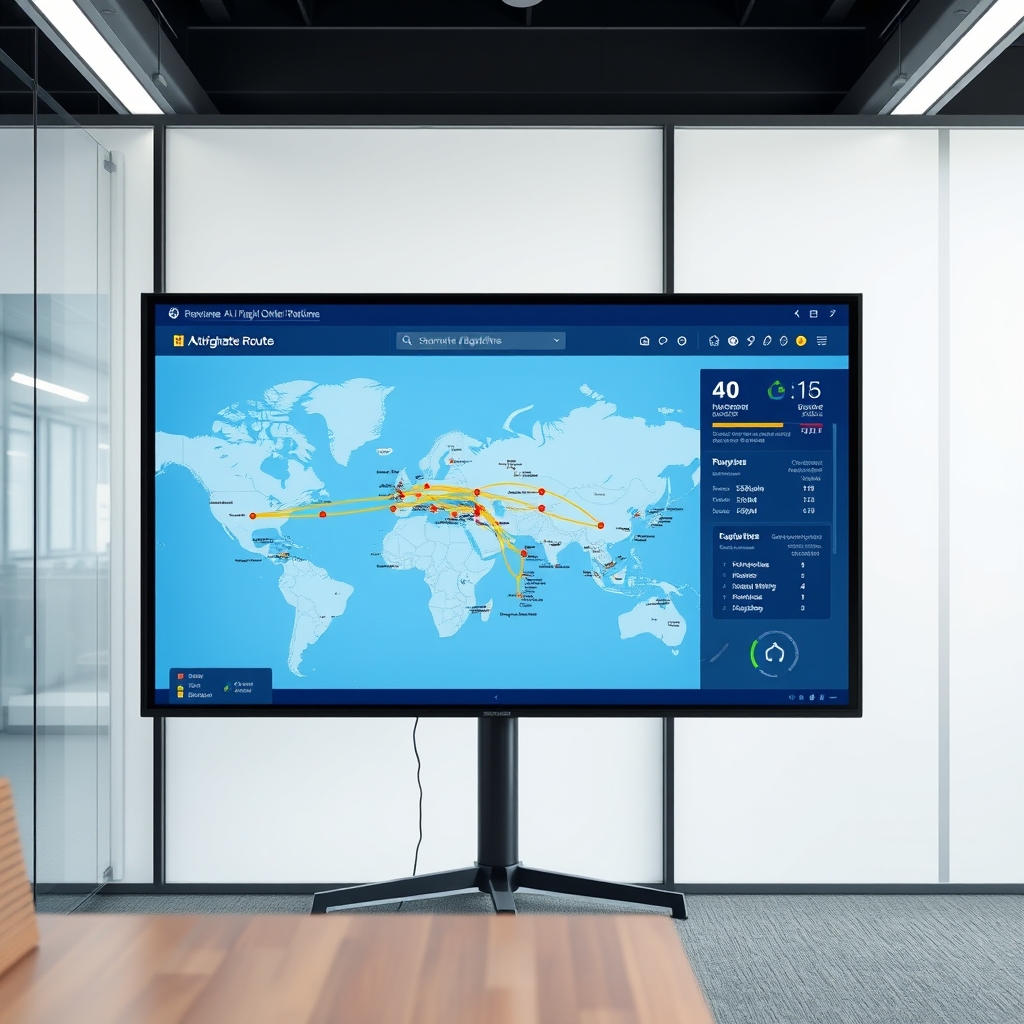
The trucking industry in the United States moves 72.6% of all freight by tonnage, consuming 54 billion gallons of diesel annually. Yet studies consistently show that 25–35% of truck miles are driven empty (deadhead), and even loaded routes are often suboptimal due to static planning, poor load matching, and reactive rather than predictive decision-making. This represents an enormous waste of fuel, driver time, and money.
AI-powered route optimization is attacking this inefficiency with unprecedented sophistication. Unlike the simple shortest-path algorithms of earlier TMS platforms, modern AI routing engines process hundreds of variables simultaneously—traffic patterns, weather, fuel prices, driver hours-of-service, delivery windows, vehicle capacity, toll costs, and even predicted future demand—to generate routes that minimize total cost rather than just distance.
Beyond Shortest Path: What Modern AI Routing Actually Does
Traditional route optimization (Dijkstra's algorithm, basic VRP solvers) answers a simple question: "What's the shortest or cheapest path from A to B?" AI-powered systems answer a fundamentally different question: "Given everything we know and predict about the world, what's the optimal set of decisions across our entire network?"
Multi-Objective Optimization
Real-world freight routing involves competing objectives. A route that minimizes fuel cost might violate a driver's hours-of-service. The fastest route might have the highest toll costs. The most fuel-efficient route might miss a delivery window. AI systems handle this through multi-objective optimization, finding the Pareto-optimal frontier of solutions and allowing planners to select based on their priorities:
- Cost minimization: Fuel, tolls, driver pay, maintenance wear
- Time minimization: Total transit time including predicted delays
- Compliance: Hours-of-service, weight restrictions, hazmat route requirements
- Service level: Meeting appointment windows, minimizing variability
- Sustainability: Carbon emissions, noise-restricted zones, low-emission zones
Predictive Traffic and Delay Modeling
Static traffic data is nearly useless for freight. A route that's clear at 6 AM is gridlocked at 8 AM. AI routing engines use:
- Historical traffic patterns: Time-of-day, day-of-week, and seasonal patterns from billions of GPS data points
- Real-time traffic feeds: Current congestion, incidents, and construction from connected vehicle data and traffic sensors
- Predictive models: ML models that predict traffic 4–12 hours ahead based on patterns, events (sports, concerts), weather, and day type
- Incident propagation: When an accident occurs on I-95, the AI predicts how congestion will propagate and proactively reroutes trucks that haven't reached the affected area yet
Dynamic Rerouting
Perhaps the most powerful capability: AI systems continuously monitor in-transit shipments and proactively reroute when conditions change. This isn't the same as a driver's GPS recalculating—it's a network-level optimization that considers all trucks, all shipments, and all constraints simultaneously. A traffic jam on I-10 in Houston doesn't just reroute one truck; the AI evaluates whether it's better to hold the truck, divert to I-45, swap loads with another truck on a different route, or adjust the delivery appointment.
💰 AI Route Optimization: Measured Results (Industry Averages, 2025–2026)
Fuel cost reduction: 8–15% (from more efficient routing and reduced idle time)
Empty miles reduction: 15–25% (from better load matching and backhaul optimization)
On-time delivery improvement: 12–20 percentage points (from predictive ETA and proactive rerouting)
Planning time reduction: 60–80% (from automated plan generation vs. manual planning)
Driver utilization improvement: 10–18% (from better HOS optimization and reduced waiting)
The Technical Architecture: How It Works Under the Hood
Data Ingestion Layer
AI routing engines are data-hungry. A typical deployment ingests:
- Real-time GPS positions from all fleet vehicles (every 30–60 seconds)
- ELD data for hours-of-service calculations
- Order/load data from TMS (origins, destinations, weights, dimensions, appointment windows)
- Traffic data from HERE, TomTom, or Google (historical + real-time)
- Weather data (current + forecast)
- Fuel price data by location
- Road restriction data (bridge heights, weight limits, hazmat restrictions)
- Toll cost data by route segment and vehicle class
Optimization Engine
The core solver combines several AI/ML techniques:
- Reinforcement learning: The system learns from the outcomes of past routing decisions. If a particular route consistently delivers late due to a construction zone not in the map data, the RL agent learns to avoid it
- Graph neural networks: Model the road network as a graph where edge weights are dynamic (changing based on time, weather, and traffic), enabling more nuanced path finding than traditional algorithms
- Metaheuristic optimization: Genetic algorithms and simulated annealing for the combinatorial aspects (which loads on which trucks, in what order) that are NP-hard to solve exactly
- Constraint programming: Hard constraints (HOS, weight limits, appointment windows) are enforced as inviolable rules within the optimization
Continuous Learning Loop
The most important differentiator: AI routing systems get better over time. Every completed trip becomes training data. Actual vs. predicted travel times are compared, and the models are updated. Seasonal patterns emerge. Carrier-specific tendencies (this carrier is always 30 minutes late at this shipper) are learned. Within 3–6 months of deployment, most AI routing platforms show measurable accuracy improvements of 15–30% over their initial calibration.
Use Cases by Freight Type
Truckload (TL)
For dedicated and contract TL operations, AI routing delivers value through:
- Multi-stop optimization: Sequencing 3–8 stops per route to minimize total miles while respecting all delivery windows
- Backhaul matching: Automatically finding profitable return loads from load boards or partner networks, reducing deadhead percentage
- Driver home-time optimization: Routing drivers to end their week near their home base, improving retention (a critical issue when driver turnover averages 90% annually)
Less-Than-Truckload (LTL)
LTL is where AI routing shines brightest, because the combinatorial complexity is enormous:
- Pickup/delivery route optimization: P&D drivers making 15–25 stops per day, with each day's route dynamically generated based on actual orders
- Linehaul network design: Optimizing which terminals connect via direct linehaul vs. hub-and-spoke, rebalancing nightly based on volume patterns
- Dock appointment scheduling: Coordinating arrival times at cross-dock facilities to minimize trailer dwell time
Intermodal
AI routing for intermodal freight optimizes the full door-to-door move:
- Mode selection: Deciding whether a shipment should move all-truck or truck-rail-truck based on transit time, cost, and carbon goals
- Rail ramp selection: Choosing the optimal origin and destination ramps considering dray distance, rail transit time, and ramp congestion
- Dray optimization: Optimizing the truck moves to and from rail ramps, combining multiple container moves on single truck runs
Implementation: A Realistic Roadmap
Phase 1: Data Foundation (Months 1–2)
Before any AI can optimize routes, you need clean, accessible data. This means:
- Ensuring all trucks have GPS/ELD connectivity and data flows to a central platform
- Standardizing address data (geocoding all shipper/receiver locations)
- Integrating your TMS order data with the routing platform via API
- Establishing baseline metrics: current cost per mile, empty mile percentage, on-time delivery rate
Phase 2: Pilot Deployment (Months 2–4)
- Start with a single region or lane segment (50–100 trucks)
- Run AI-optimized routes in parallel with planner-generated routes for 4–6 weeks to validate
- Measure actual vs. predicted outcomes and calibrate models
- Build planner trust by showing them why the AI made each decision
Phase 3: Scale and Automate (Months 4–8)
- Expand to full fleet with AI generating initial route plans
- Move from "AI suggests, human approves" to "AI executes, human reviews exceptions"
- Enable dynamic rerouting for in-transit adjustments
- Integrate with carrier/driver mobile apps for real-time route updates
Phase 4: Advanced Optimization (Months 8–12)
- Add demand forecasting to pre-position capacity before orders arrive
- Implement cross-customer optimization (for 3PLs: combining shipments from multiple customers on shared routes)
- Deploy sustainability optimization: minimum-carbon routing as a selectable objective
Vendor Landscape: Key Players in 2026
The AI route optimization market has consolidated around several major players and emerging innovators:
- Established TMS with AI add-ons: Oracle Transportation Management, Blue Yonder, and SAP TM have all added ML-based optimization modules. Strength: integration with existing TMS workflows. Weakness: optimization is often a feature, not the core product
- Pure-play optimization platforms: Wise Systems, Optym, ORTEC—these companies focus exclusively on optimization algorithms. Strength: best-in-class solvers. Weakness: require integration with existing TMS
- Visibility + optimization convergence: FourKites, project44, and Transplace are adding optimization capabilities to their visibility platforms, creating closed-loop systems where visibility data feeds directly into route decisions
- AI-native startups: Companies like Optimal Dynamics and Mosaic (formerly Loadsmart's routing team) are building from scratch with modern AI architectures, often showing faster improvements through reinforcement learning
The ROI Equation
For a fleet of 500 trucks averaging 100,000 miles per truck per year:
- Total annual fuel spend: ~$32M (at $6.50/gallon, 6.5 MPG average)
- 10% fuel reduction from AI routing: $3.2M annual savings
- 20% reduction in empty miles (currently 30%): Equivalent to adding 100 productive trucks without buying them
- AI routing platform cost: $300K–$800K annually
- Net ROI: 4–10x in the first year
The math is compelling, and it's why AI route optimization has moved from "innovative experiment" to "table stakes" for competitive freight operations in 2026. Companies that are still planning routes with spreadsheets and experience-based intuition are leaving millions on the table—and their competitors are picking it up.
Smarter Freight Starts with Better Data
FreightPulse's rate and route intelligence API feeds directly into leading AI optimization platforms.
Start Free Trial →